Published 2026-07-09 ・Last updated 2026-07-31
How to Learn Katakana with a Memory Game (Free)
Can read hiragana but stuck on katakana? Can't tell シ from ツ, or ソ from ン? Plenty of learners hit a wall with katakana. It has many look-alike characters and shows up less often than hiragana, so it's harder to make stick. This guide covers how a memory game that pairs each character with its reading helps you learn katakana for good, plus how to practice with a free tool.
It is not only the shapes that make katakana hard
The look-alikes are certainly part of it. シ and ツ, ソ and ン, ク / ワ / ケ, ス and ヌ, チ and テ, マ and ム, ナ and メ — far more pairs differ by only a stroke angle than in hiragana.
But the bigger factor is exposure. Hiragana appears in every line of every picture book and textbook as the connective tissue of the sentence; katakana is confined to loanwords, onomatopoeia and symbolic uses. With fewer encounters, what you learn fades before it settles. "I learned it and forgot it again" is almost always this, not a failure of memory.
That points the countermeasure somewhere specific: rather than cramming more in at once, increase the number of times you have to pull it back out.
A memory game forces the number of retrievals up
Looking at a chart is input. Asking yourself "what does this one say?" is output — and it is mainly the second that strengthens memory (active recall).
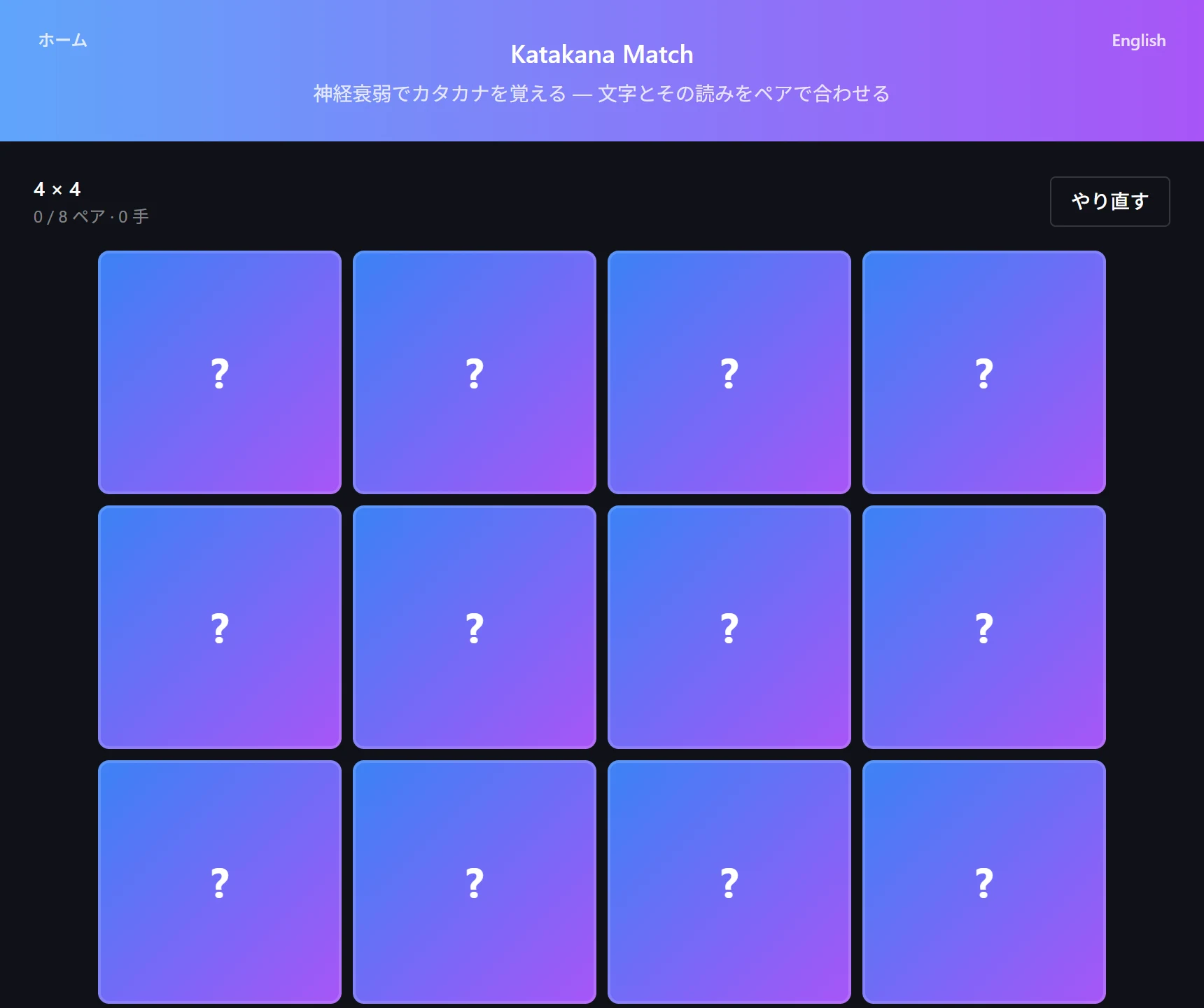
Katakana memory match makes that output structural. Flip ア and the card you now need is あ or a. For the seconds you spend searching, your head has to hold the pairing "ア is a". And if the second card is wrong, you have to recall the same pairing again. By the time one pair is cleared you have retrieved the same character several times over — that is the decisive difference from reading a chart.
It also helps that a miss carries no sting. Turning over the wrong card is part of the game, so it never registers as getting something wrong — which keeps the aversion that often builds around character drills from forming.
Start from hiragana pairs or from romaji pairs?
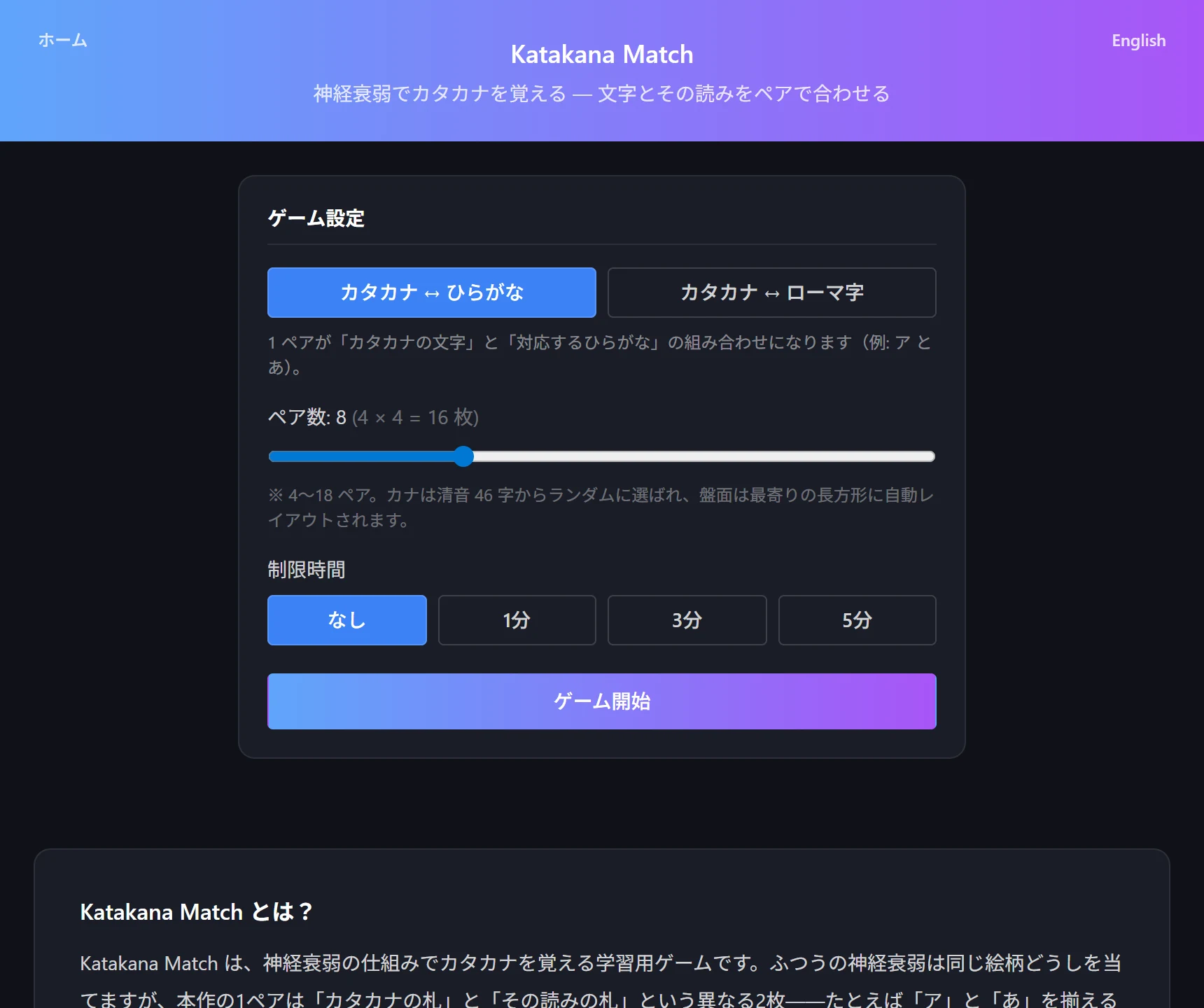
There are two modes, and they change what a pair consists of. Hiragana mode pairs ア with あ; romaji mode pairs ア with a.
For a Japanese-speaking child, hiragana mode comes first. It attaches new shapes to characters they already know, so there is only one unknown — the shape correspondence. Romaji mode asks them to handle katakana shapes and romaji spellings at the same time, doubling the load.
Conversely, for someone learning Japanese as a foreign language, or anyone who has not studied hiragana, romaji mode is the right entry point: the alphabet is the known side, so building from there is natural.
Pair counts run from 4 to 18. The board automatically lays out into the nearest rectangle for whatever count you pick, so an awkward number never breaks the layout.
How to play (Katakana Match)
Characters are drawn at random from the 46 basic katakana. The board in progress is auto-saved on your device, so closing the page mid-game does not lose it.
- Open Katakana Match and choose a mode (Katakana ↔ Hiragana / Katakana ↔ Romaji)
- Pick the pair count (4–18) and set a time limit if you want one
- Flip cards to match each character with its reading
- A matched pair stays face up side by side — read it aloud once at that point
Learn the look-alikes by stroke direction, not by shape
Staring at シ and ツ side by side does not separate them. Learning the direction you draw the strokes turns out to be the fastest route.
シ and ン have their dots stacked horizontally and finish with a stroke sweeping from bottom to top. ツ and ソ have their dots stacked vertically and finish with a stroke going from top to bottom. Both the dot orientation and the sweep direction change together. Tracing the shape in the air while saying "シ goes up" sticks better than looking alone.
ク, ワ and ケ divide by where the second stroke begins: partway along the first stroke for ク, at its left end for ワ, and cutting through it downward for ケ. Another group that is faster to learn by writing.
Rather than chasing all 46, set the pair count to 4–6 and work one row at a time — the A-row, then the Ka-row — widening the range you can reliably read. Cycling a narrow range repeatedly beats one thin pass over everything.
- シ / ン → dots stacked horizontally, final stroke sweeps upward
- ツ / ソ → dots stacked vertically, final stroke goes downward
- ク / ワ / ケ → tell apart by where the second stroke starts
- Start at 4–6 pairs, one kana row at a time, and widen gradually
Try the tool featured in this article — free, right now.
Use Katakana MatchFrequently asked questions
- Q. Can I use it if I'm not confident with hiragana yet?
- A. Yes — Katakana ↔ Romaji mode lets you practise with romanized readings without going through hiragana. If you do know hiragana, Katakana ↔ Hiragana mode attaches each new shape to one you already know, which is a lighter load.
- Q. Does it cover dakuten and small kana (ャュョ)?
- A. To keep it simple for beginners, it focuses on the 46 basic (seion) katakana (ア to ン). Nailing the basics is the foundation for the voiced and combination kana later.
- Q. How many pairs should I start with?
- A. Four to six, split by kana row — just the A-row, then just the Ka-row. Cycling a narrow range repeatedly retains far better than one thin pass over all 18 pairs. Raise the count as the number of characters you can read grows.
- Q. Is any data saved or sent?
- A. The in-progress game is auto-saved only in your device's localStorage; the cards and your progress are never transmitted (ads and analytics are loaded site-wide, separately from the game). You can resume after a reload.