
Published 2026-07-09 ・Last updated 2026-07-31
A Money-Counting Game That Teaches Kids to Pay with Coins (Free)
"Which coin is 100 yen?" "Is that enough?" — learning to count money is a life skill kids use every day. Practicing with real coins is ideal, but a digital game lets them repeat as often as they like with nothing to lose. This guide covers how a "checkout play" game — hear an amount, then pay it with coins — helps children learn to tell coins apart and add them up, plus how to play with a free tool.
"Understanding money" is really three separate skills
Children who struggle with money usually are not stuck on money as a whole — they are stuck on one of three distinct skills. The first is telling coins apart: distinguishing 1, 5, 10, 50, 100 and 500 yen by colour, size and the number stamped on them. The second is adding up: totalling several coins. The third is equivalence — accepting that five 10-yen coins and one 50-yen coin are worth the same.
These do not arrive in order. Some children can name every coin fluently yet cannot count three 10s as 30; others are strong at addition but keep mixing up the 50 and the 100. Repeating "let's try again" without working out which of the three is failing just walks them into the same wall over and over.
Equivalence is the one most often overlooked. It is obvious to adults, but to a child it is counter-intuitive that "many small coins" balances "one big coin". Japanese coins make it worse: physical size does not track value — the 1-yen coin is larger than the 5, and the 5 is smaller than the 50.
- Telling apart — distinguish six coins by colour, size and printed number
- Adding up — total several coins; counting in fives and tens is the foundation
- Equivalence — understand the same amount can be built in more than one way
What changes when you "pay" instead of filling in a worksheet
"35 yen is how many 10s and how many 5s?" on a worksheet, and being asked for 35 yen and choosing the coins yourself, are two very different tasks for a child. The first has one fixed answer that has to be worked out before anything is written down. The second can be rearranged as you go, and thought about while doing it.
That "think while placing" quality matters enormously for a beginner. Once three 10-yen coins are down and the total reads 30, the next move is visible: five more. Nothing has to be held in the head, so working memory is freed up for the actual thinking.
The other difference is that a mistake comes back as a direction rather than a cross. A cross tells you nothing about what went wrong; "too much" tells you to take a coin away. Trial and error moves forward instead of stalling.
Difficulty is set by which coins appear, not by how big the amount is
The three levels in Coin Pay are not simply bigger and bigger amounts. What changes is which coins are in play.
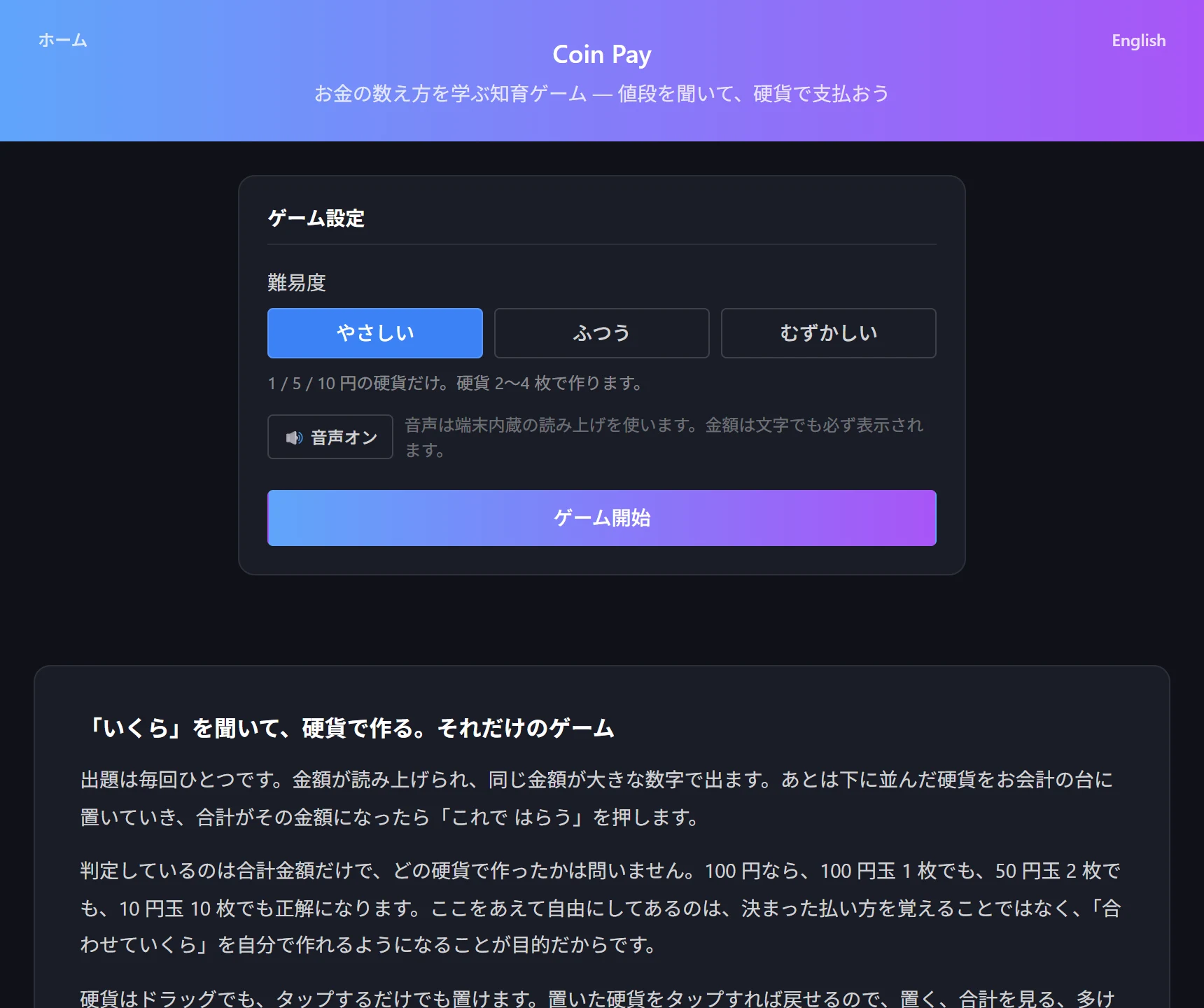
Easy uses only 1, 5 and 10 yen. Normal adds the 100. Only Hard brings in the 50 and the 500, for all six coins. Holding the 50 and 500 back is deliberate: the "fives" are the most confusing group. With 1, 10 and 100 the digit matches the place value directly, but 5, 50 and 500 introduce a second rule — two of them make the next place. Mixing that in before counting in tens is solid tends to break the adding up itself.
The number of coins changes too: two to four for Easy and Normal, four to six for Hard. Each target amount is generated by actually picking that many coins from the set and totalling them, so it can always be paid with the coins on screen. No child ever gets stuck on an impossible amount.
How to play (Coin Pay)
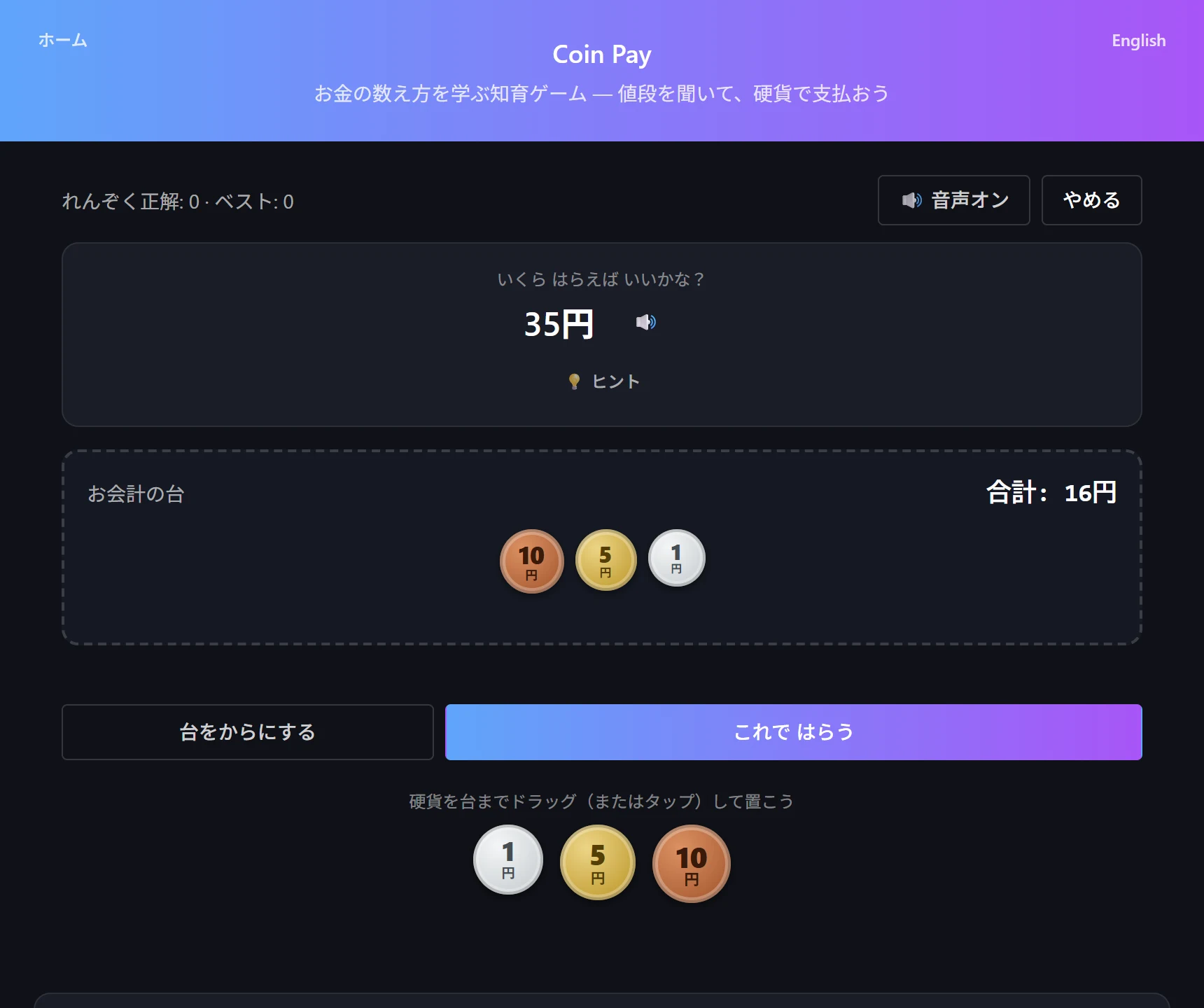
Coin Pay announces a target amount by voice and text, and you pay it by placing coins on the checkout tray. Speech uses the voice built into your device and the chimes are generated on the fly, so the game itself uploads nothing.
- Open Coin Pay, choose a difficulty (Easy / Normal / Hard) and press start
- The amount is read aloud. "Hear the amount again" replays it as often as needed, and it is always shown in text too
- Drag a coin from the palette onto the tray. Tapping works as well
- Tap a coin already on the tray to take it back. The total updates with every change
- When the total matches, press "Pay this." Only an exact match counts, and the streak goes up by one
Common ways children get stuck — and what to say
Watch for a while and the failures fall into a handful of patterns. Knowing the pattern changes what is worth saying.
The most common is laying out 1-yen coins one after another, with no instinct to reach for a bigger coin. Nothing is wrong with it, so there is no need to stop it — but showing once that "one 100 is the same as a hundred 1s" often shifts the approach from the next round on.
Next is confusing 5 with 50, or 100 with 500. They look alike. Tracing the number with a finger and reading it aloud together settles it quickly.
Overshooting the target is sometimes not a counting problem at all — placing coins is fun and they simply do not stop. If asking "how much more?" once is enough to land on the answer, the skill was never the issue.
When no combination comes to mind, the hint button faintly shows one valid set. Copying it, then trying the next question without the hint, widens the range they can solve alone after a few rounds.
- Only 1-yen coins → show the same amount swapped for a bigger coin
- Mixing up 5/50 or 100/500 → trace the number and read it aloud together
- Overshooting → ask "how much more?" to interrupt the placing
- No combination comes to mind → use the hint and copy the example
Finish with real coins
Once amounts come together on screen, build the same one out of real coins. Real money has weight and texture; the heft of a 500-yen coin and the flimsiness of a 1-yen coin never come through a display. Tying that feel to relative value changes how well it sticks.
From there, move to shopping. Paying at a real till is ideal, though a queue behind you adds pressure. Playing shop at home — "this juice is 120 yen" — and then handing over too much to get change back joins up all three skills from the start of this article.
Try the tool featured in this article — free, right now.
Use Coin PayFrequently asked questions
- Q. What age is it for?
- A. A good time is once a child can read numbers a little and is starting to tell coins apart. Easy uses only three coins — 1, 5 and 10 yen — so it suits a first introduction to money. Reading the amount together with a caregiver at first works well.
- Q. Can they practise working out change?
- A. No. Coin Pay is deliberately limited to paying the exact amount; overpaying and receiving change is not covered. Subtraction is easier to approach once adding up is solid, so use this to settle coin combinations first and practise change with real coins in play-shop form.
- Q. Why is there no 50-yen coin in Normal?
- A. Because 5, 50 and 500 introduce a rule that 1, 10 and 100 do not: two of them make the next place. Mixing that in before counting in tens is solid tends to break the adding up itself, so the 50 and 500 are held back until Hard.
- Q. Can we learn without real money?
- A. The on-screen coins are enough to practise telling coins apart and adding them up. Weight and texture do not come through a screen, though, so finishing with real coins is worth doing.
- Q. Is any data saved or sent?
- A. Only the best streak per difficulty is saved, and only in your device's localStorage. Your payments and results are not sent to a server. Separately, the site as a whole does load analytics and ads.