
Published 2026-07-24 ・Last updated 2026-07-31
A Game to Teach Kids Addition and Subtraction (Free, with Dots)
"What’s 5 plus 3?" Single-digit addition and subtraction are the foundation of math, yet doing it in your head from bare numbers is surprisingly hard for a 5–7 year old. The goal isn’t to memorize answers, but to build a real feel for number groups. This guide shows how dot visuals and read-aloud problems help kids move from counting on fingers toward mental math, plus how to practice with a free tool.
See numbers as groups, not one-by-one
Fast calculators don’t count "●●●●●" one dot at a time — they see "a group of five" at a glance. This ability to know a quantity without counting (number sense, or subitizing) largely determines the speed and accuracy of addition and subtraction.
That’s why showing dots alongside the numbers helps at first. Present "5 and 3" as clusters of dots and kids can see them combine into 8, or see that taking 3 from 8 leaves 5. Learning the make-up of numbers as pictures (5 is 2 and 3; 10 is 6 and 4…) is the groundwork for later mental math.
- Pair numerals with dots to grasp "number groups"
- Learn composition/decomposition as pictures (5 = 2 and 3, 10 = 6 and 4)
- Thinking in tens makes carrying much easier
- Value how they thought about it, not just the answer
Dots for addition and dots for subtraction have to look different
Simply showing dots is not enough, because addition and subtraction need to make different things visible.
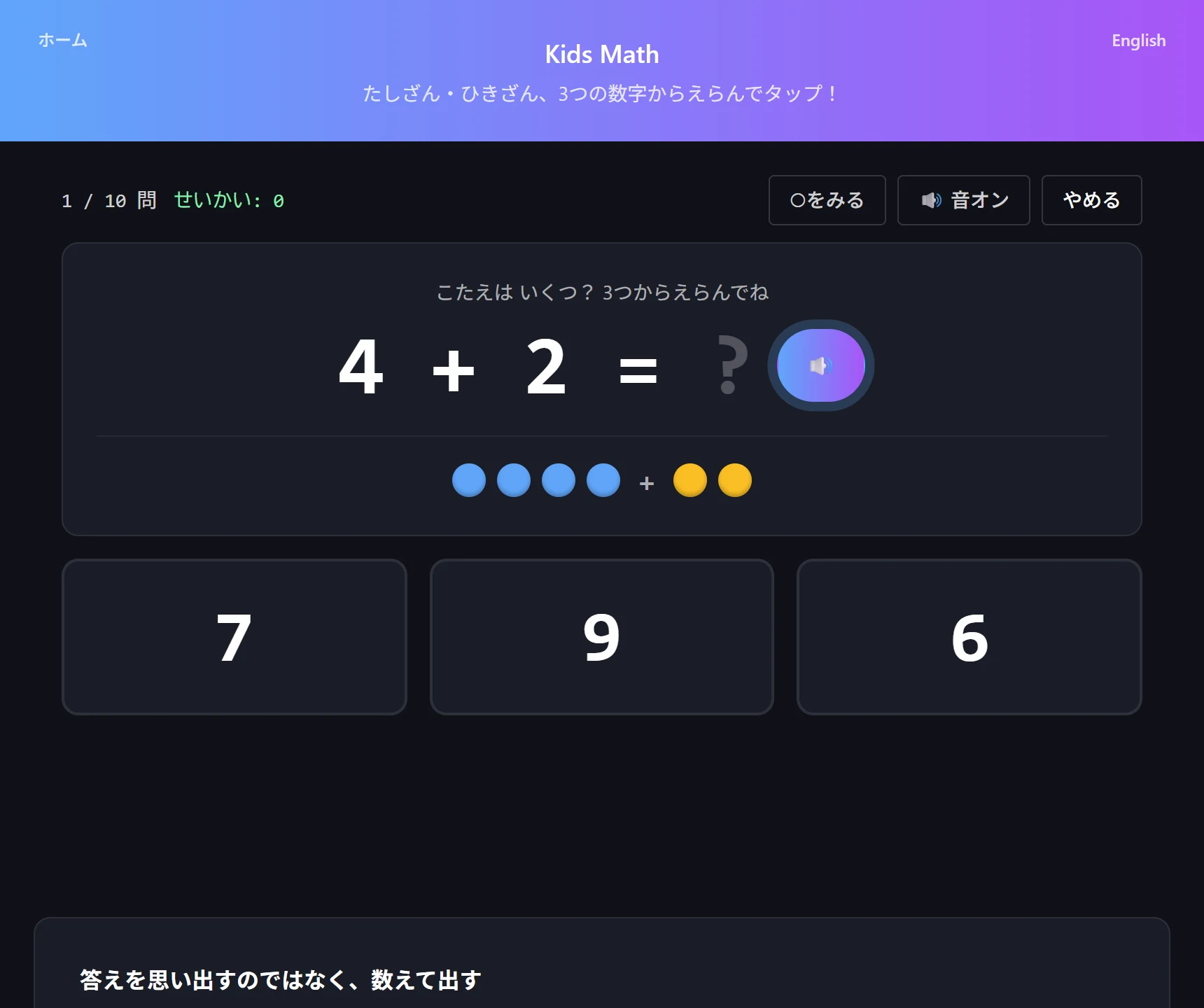
What matters in addition is that two sets become one. For 3 + 2, Kids Math lays out three dots and two dots in separate colours — blue and orange. Five dots in a single colour would just be "five"; the fact that a 3 and a 2 came together would have vanished. Splitting the colours keeps the original parts visible inside the answer.
Subtraction is harder, because "taking away" is an invisible action. Here the app lays out the full starting quantity and then crosses out the ones being removed. The dots do not simply appear in their reduced number — something that was there gets struck through. That difference is what makes the operation land.
Why the problem is spoken and the answer is one of three
Ask a five-year-old to read the equation and decoding the digits and symbols uses up everything they have, leaving nothing for the maths. Reading it aloud removes that load entirely. Hear it, check it against the dots, tap the answer — the more senses involved, the better it holds.
Three choices rather than free entry is the same reasoning. Operating a keypad or forming digits is effort unrelated to the calculation. Narrowing it to "which one?" keeps the attention where it belongs, and a miss costs nothing but a retry.
Three choices have a side benefit too. Scanning the options and ruling one out as obviously wrong quietly builds estimation. If 7 + 5 offers a 3, no calculation is needed to reject it — and being able to make that judgement is a real numerical skill.
The difficulty levels also decide when the dots go away
The three levels change more than the range of numbers: they change whether the dots are shown from the start.
Easy is addition only, each term 1–5, no carrying, and dots on. Normal adds subtraction, keeps sums within 10 and still has no carrying — dots on here too. Hard brings in carrying and borrowing with sums up to 18, and it is the only level where dots default to off.
That is not meanness; it is the handover to mental arithmetic. As long as dots are available, counting always produces an answer, so children keep counting. By the time they reach Hard, most have begun to internalise the sums up to ten, and the natural pattern becomes: try without dots, and call them up with the button only when stuck. The dots have not been removed — they have become something you summon when needed.
How to play (Kids Math)
A round is ten questions. Speech uses the voice built into your device and the chimes are generated on the fly, so no record of the practice leaves the browser.
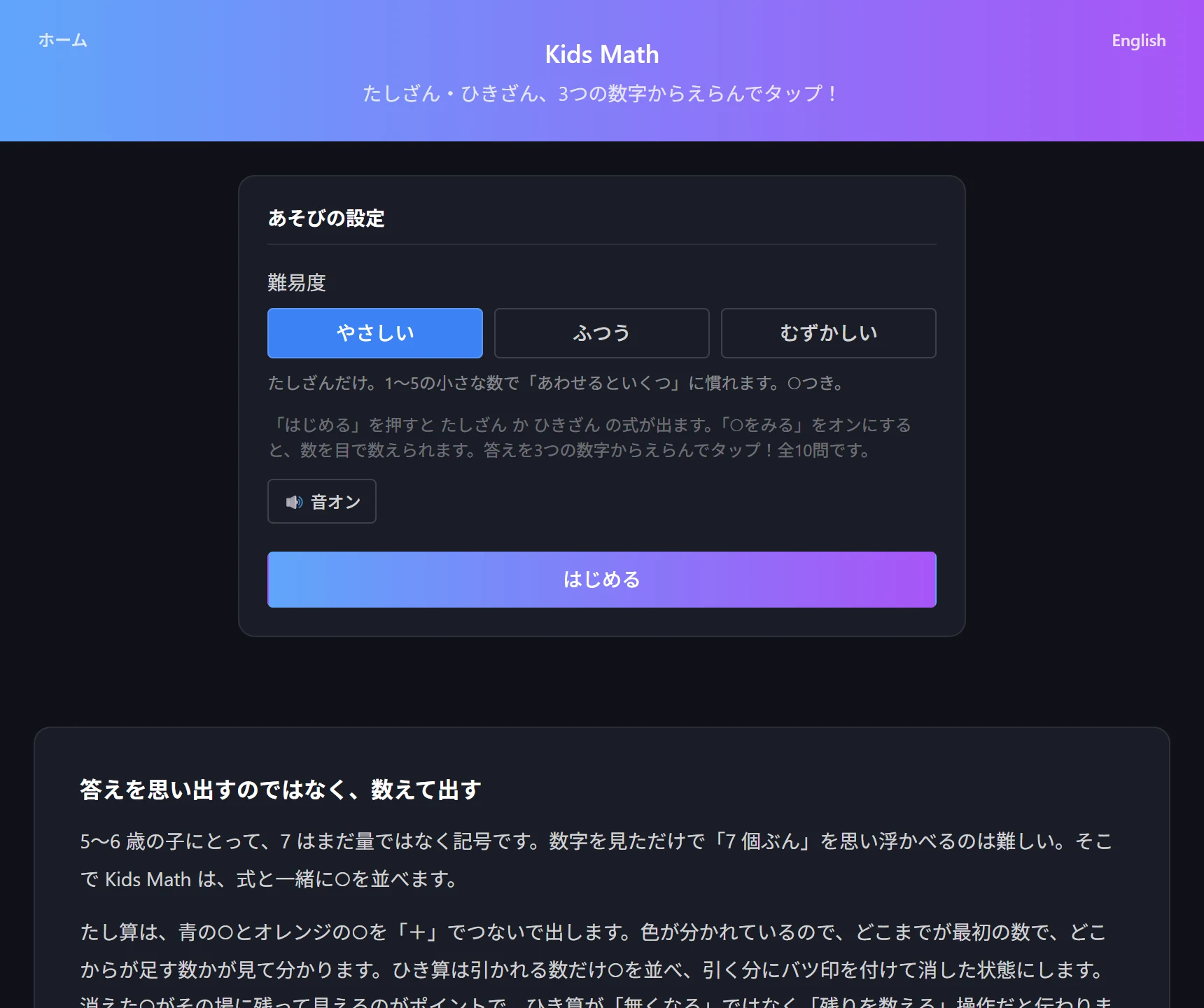
- Open Kids Math, choose a difficulty and press start
- The problem is read aloud; "hear it again" replays it as often as needed
- Turn on the dots if you want to check the quantity by eye
- Tap the answer from three choices; a wrong choice is marked on the spot
- Ten questions per round, with a best score kept per difficulty on the device
From finger-counting to mental arithmetic — when to make the switch
Counting on fingers is fine at the start; fingers are the first tool for linking numbers to quantity. But starting from 1 every time caps how far they can get, so use the dots to draw attention to groups of five and ten, and move towards counting on — "after 5 comes 6, 7". Once counting on arrives, the time per question drops visibly.
The carrying barrier is crossed by making a ten. For 9 + 4: "9 needs 1 to reach 10, and 3 is left, so 13." Working through that split while looking at the dots turns it into a mechanism rather than a memorised procedure. Conversely, a child who answers 9 + 4 = 13 without dots but cannot explain why is still at the memorising stage.
For gauging progress, watch the pause before the answer rather than the score. Ten correct with a long think before each one still means counting. When the pauses shorten, it is time to move up a level.
Try the tool featured in this article — free, right now.
Use Kids MathFrequently asked questions
- Q. What age can play this?
- A. A good fit is roughly ages 5–7, once a child can read numbers a little and count to about 10. Start with Easy — addition only, terms 1–5 — looking at the dots together.
- Q. My child still counts on fingers — should I stop that?
- A. There is no need to force a stop. Finger-counting is an important stage that links numbers to quantity. As children start noticing "groups" with the dots, they naturally shift to counting on and from there to mental arithmetic.
- Q. Why do the dots start off only on Hard?
- A. To encourage the move to mental arithmetic. While dots are on screen, counting always yields an answer, so children keep counting. By Hard, sums to ten are usually starting to stick, so the intended pattern is to try without dots and press the button only when stuck. Turning them on does not affect the recorded score.
- Q. Is any data saved or sent?
- A. Only the best result per difficulty is stored in your device’s localStorage (kids-math:best:v1). Problems are read with your device’s built-in voice, with no external communication or upload.